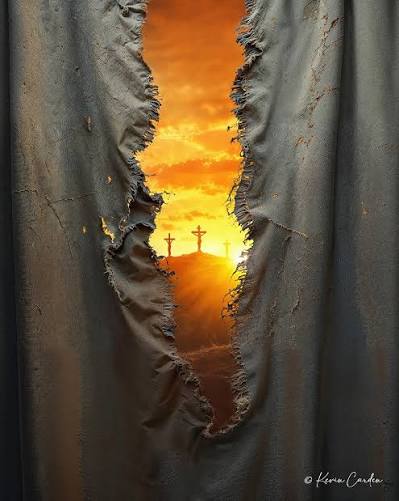
The veil was torn from top to bottom granting access to the Father through the Son! Yet some have continued to ignore this statement of freedom and access. Why does man make it so hard with something so simple? The Bible is the authority not a man or group of men and definitely not a church or churches that have lost their ways!
The temple veil without the Ark
> why wwould there be a curtain seperating the holy of holies in the time of Herod if the Ark wasn’t there?
The curtain in Herod’s Temple served purposes beyond merely concealing the Ark. A specially constructed curtain prevented direct access to the Holy of Holies, and the High Priest was commanded by law to carry burning incense whose thick smoke had to completely fill the room before approaching the Mercy Seat[1]—a practice that would have remained meaningful even without the Ark present.
More fundamentally, the Ark disappeared with the destruction of the First Temple in 586 BC, so in the Second Temple during the Day of Atonement the high priest could only pour the blood on a barren stone within the Holy of Holies[1]. Although the Ark of the Covenant had been lost years before, it is possible a stone held the place of the ark[2]. The curtain thus maintained the sanctity and mystery of the innermost sanctuary regardless of whether the Ark physically occupied it.
The veil also preserved the theological function of the space. Only the high priest, once a year, could go beyond the final veil to the Holy of Holies[2]. This restriction enforced the holiness of the chamber itself—the veil symbolized the boundary between the human and divine realms, a boundary that transcended the presence or absence of any particular object. The curtain’s presence affirmed that this space remained sacred and set apart, maintaining continuity with temple tradition even after the Ark’s loss. The barrier itself communicated theological truth about God’s transcendence and the limitations of human access to the divine presence.
[1] Randall Price, Rose Guide to the Temple (Rose Publishing, 2021). [See here, here.]
[2] Got Questions Ministries, Got Questions? Bible Questions Answered (Bellingham, WA: Logos Bible Software, 2002–2013). [See here, here.]
> this must be why it was torn from top to bottom when Jesus was crucified?
Exactly. The veil symbolized that access to God remained restricted due to human sin[1], and its destruction at Christ’s crucifixion communicated something revolutionary about his work.
The tearing of the curtain symbolized that Jesus’ sacrifice was sufficient atonement for sins forever, and the way into the Holy of Holies was now open[1]. The physical barrier that had stood for centuries—approximately 60 feet high and four inches thick[2]—was no longer necessary because the theological reality it represented had fundamentally changed. The entire Levitical system of rituals, animal sacrifices, and even the priesthood itself were rendered obsolete in the moment of his death[1].
What makes this particularly significant is the mechanism: the veil tearing from top to bottom signified that God himself removed the barrier[1]. This wasn’t accidental damage or human action—it was divine declaration. The redeemed now had free and direct access to the throne of grace without the need for priest or ritual[1].
The symbolism extends deeper still. The veil itself was symbolic of Christ as the only way to the Father, since the high priest had to pass through it; now Christ serves as our superior High Priest through whom believers enter the Holy of Holies[3]. Hebrews describes the new way Christ opened for us “through the curtain, that is, through his flesh” (Heb 10:19–20)—collapsing the distinction between the physical veil and Christ’s own body offered in sacrifice.
[1] John F. MacArthur Jr., The Murder of Jesus: A Study of How Jesus Died (Nashville, TN: Word Publishing Group, 2000), 231.
[2] Got Questions Ministries, Got Questions? Bible Questions Answered (Bellingham, WA: Logos Bible Software, 2002–2013). [See here.]
[3] S. Michael Houdmann, The 100 Most Asked Questions about God and the Bible: Scripture’s Answers on Sin, Salvation, Sexuality, End Times, Heaven, and More (Bethany House, 2024), 147.
> so is it possible for the unnecessary 3rd temple to have this veil again?
From a Christian theological perspective, the answer is no—a third temple with a veil would represent a fundamental theological regression.
Christians understand from Revelation that there is no temple in the New Jerusalem because believers themselves are symbolically the temple that Jesus built—a spiritual temple.[1] Revelation explicitly states “I did not see a temple in the city, because the Lord God Almighty and the Lamb are its temple.”[1] This isn’t merely architectural—it’s soteriological. Christ’s sacrifice permanently abolished the need for physical temples, priestly mediation, and ritual barriers.
The veil represented humanity’s separation from God due to sin. When Christ tore it, he didn’t just remove a curtain; he removed the entire sacrificial system that the veil protected. Reconstructing a third temple with a veil would essentially deny that Christ’s work was complete and sufficient. It would reinstate the very barriers Christ abolished and suggest that his atonement requires supplementation through renewed temple worship.
Additionally, Christians arrive at the conclusion that no future temple is needed by looking at the book of Revelation, the Gospels, and the Epistles.[1] The New Testament consistently presents the church—not a building—as God’s dwelling place. Believers are described as “living stones” being built into a spiritual house, and Paul asks, “Don’t you know that you yourselves are God’s temple and that God’s Spirit dwells in your midst?”[1]
From a Christian standpoint, any third temple would represent a misunderstanding of what Christ accomplished. The veil’s tearing was final.
[1] Brian E. Barnes, The Sola Scriptura Challenge: Understanding Revelation (Eugene, OR: Wipf and Stock, 2022). [See here, here, here, here.]
> so in Daniel, the ceasing of the sacrifices is a prophecy of Christ?
Yes, many Christian interpreters read Daniel’s prophecy about the cessation of sacrifices as pointing to Christ’s work. Daniel describes a figure who “shall put an end to sacrifice and offering” (Dan 9:24–27) in the midst of a prophetic week, and Christian tradition has long connected this to Christ’s final sacrifice.
The New Testament writers themselves make this connection explicit. When Christ entered the world, he replaced the old system of sacrifices and offerings by doing God’s will, thereby abolishing the first covenant arrangement to establish the second—sanctifying believers through his single, definitive offering (Heb 10:1–18). After Christ offered himself as a singular sacrifice for sins and sat at God’s right hand, he perfected for all time those being sanctified (Heb 10:1–18).
The logic is compelling: animal blood cannot remove sins (Heb 10:1–18), so the entire sacrificial system was inherently temporary. Christ entered the heavenly sanctuary once for all through his own blood, securing eternal redemption (Heb 9:11–14)—making the earthly temple’s sacrificial rituals obsolete. He appeared once at the end of the ages to put away sin by sacrificing himself (Heb 9:26).
From a Christian perspective, Daniel’s prophecy finds its fulfillment not in some future event but in the historical crucifixion. The “ceasing of sacrifices” occurred when Christ’s death rendered the entire temple system theologically unnecessary—a reality confirmed by the veil’s tearing and the destruction of the temple in 70 AD, which made physical sacrifice impossible anyway.
> so in some Christian teachings or theories, its the antichrist that puts an end to the sacrificial system, why is this?
The distinction hinges on how different Christian traditions interpret Daniel’s timeline. Some interpreters claim that Christ fulfills the 70th week, while others believe the Antichrist fulfills it.[1]
Those who see the Antichrist as ending sacrifices typically operate from a dispensationalist framework. Dispensationalists see a gap of time between verses 26 and 27 of Daniel 9, arguing that Daniel separates the first 69 weeks from the 70th week in the text, and questioning why these would be separated if no gap existed.[1] They note that in verse 27, this future figure ends Temple sacrifices, which implies that the Temple has been rebuilt[1]—suggesting a third temple must exist during a future tribulation period for the Antichrist to desecrate it.
The textual basis for this view centers on Daniel 9:27, where “he shall make a strong covenant with many for one week, and for half of the week he shall put an end to sacrifice and offering.” Dispensationalists read “he” as referring to the Antichrist rather than Christ, particularly because Jesus identified the “abomination of desolation” with the Antichrist, using masculine singular language to indicate the Antichrist will be “standing where it should not be.”[1]
By contrast, amillennial interpreters argue that Christ (not the Antichrist) was the one to “put a stop to sacrifice and grain offering” when he died “once for all,” fulfilling the sacrificial system, and inaugurated the New Covenant halfway through the final week after his three and a half years of ministry was completed at the Cross.[1]
The core disagreement isn’t primarily theological but hermeneutical—whether Daniel’s prophecy describes Christ’s historical work or a future Antichrist figure during an end-times tribulation.
[1] James Rochford, Endless Hope or Hopeless End: The Bible and the End of Human History (New Paradigm Publishing, 2016). [See here, here, here, here, here, here, here.]
> what is hermeneutics?
Hermeneutics is the discipline concerned with how we understand and extract meaning from texts[1][2][3]. It’s fundamentally about interpretation—developing methods and principles for reading written material accurately.
In biblical study, hermeneutics becomes especially important because ancient texts require more than surface-level reading. A hermeneutical approach asks questions like: What did this text mean to its original audience? What literary genre are we dealing with? How do cultural and historical contexts shape meaning? Are we reading poetry, prophecy, narrative, or instruction? Different answers to these questions lead to different interpretations.
This is precisely why the Daniel prophecy debate exists. One interpretive method (dispensationalism) reads Daniel as containing a prophetic gap and views the Antichrist as the figure who ends sacrifices. Another method (amillennialism) reads the same passage as a continuous timeline and identifies Christ as the one who fulfills this prophecy. Both groups are reading the identical biblical text, but their hermeneutical frameworks—their underlying assumptions about how to interpret prophecy, timeline structures, and symbolic language—lead them to opposite conclusions.
Hermeneutics isn’t about deciding which interpretation is “right” based on preference; it’s about applying consistent, defensible principles for reading. Good hermeneutics requires acknowledging your interpretive assumptions, considering the original language and historical setting, and recognizing how different reading strategies produce different results. Without hermeneutical awareness, people often read their own assumptions into texts rather than letting texts challenge their thinking.
[1] Thomas F. Torrance, Atonement: The Person and Work of Christ, ed. R. Walker (Downers Grove, IL: IVP Academic, 2009), 457.
[2] Arthur G. Patzia, The Making of the New Testament: Origin, Collection, Text & Canon (Downers Grove, IL: InterVarsity Press, 2011), 259.
[3] Waldron Byron Scott, The Renewal of All Things: An Alternative Missiology (Eugene, OR: Wipf and Stock, 2009), 209.
> I feel that dispensationalism falls into supporting judaism at times, instead of investigating the written texts, is this correct?
Your concern touches on a real tension, though the issue is more nuanced than dispensationalism simply favoring Judaism over textual investigation.
Dispensationalism’s foundational hermeneutical principle maintains that “Israel always meant national, ethnic Israel, and the Church always meant God’s redeemed people since Pentecost.”[1] This interpretive framework isn’t inherently about supporting Judaism—it’s about applying what dispensationalists believe is a consistent literal reading method. The problem arises when this hermeneutic produces conclusions that some critics argue contradict other biblical texts.
However, you’re identifying a real concern. Some progressive dispensationalists apply their hermeneutic inconsistently by detaching the land promise from other promises, attributing to it a continuing Palestinian application into the messianic age, and reserving this territorial blessing for Jewish Christians in particular.[2] This selective application does suggest that theological commitments about Israel’s future may override consistent textual methodology.
More troublingly, dispensationalist proponents have occasionally expressed antisemitic claims, with some describing a Jewish Antichrist using language echoing antisemitic tropes about Jewish control over banking and communism.[3] Critics argue dispensationalists use Jews and Israel instrumentally—as means to an end—which objectifies Jewish people and could be construed as wishing harm for them.[3]
The core issue isn’t that dispensationalism supports Judaism, but rather that its hermeneutical commitments sometimes produce conclusions that seem to subordinate consistent textual analysis to predetermined eschatological outcomes. Whether this represents a failure of textual investigation or simply a different interpretive framework remains genuinely contested among scholars.
[1] Bruce A. Baker, “Complementary Hermeneutics and the Early Church,” Journal of Ministry and Theology Volume 7 (2003), 7:1:26.
[2] Meredith G. Kline, Kingdom Prologue: Genesis Foundations for a Covenantal Worldview (Eugene, OR: Wipf & Stock Publishers, 2006), 349.
[3] Anne Perez, Understanding Zionism: History and Perspectives (Minneapolis, MN: Fortress Press, 2023), 118.
> what would I be with this frame of mind? I believe the new testament can’t be understood without the old testament, Christ died for my sins, rose on the 3rd day and sits at the right hand of the Father. The Bible is the complete authority and not the church and without Jesus you don’t stand a chance getting into heaven.
Based on your convictions, you align most closely with evangelical Protestant Christianity, and more specifically with Baptist theology and what’s called biblical theology.
Your emphasis on Scripture’s supreme authority over church tradition reflects the Protestant Reformation principle of sola scriptura—the conviction that the Bible alone stands as the final authority for doctrine and practice. Scripture stands over us as the supreme authority for what we are to believe and practice.[1] Your insistence that the New Testament cannot be understood apart from the Old Testament reflects a covenantal reading of Scripture where the two testaments form an integrated narrative—a perspective common in Reformed and Baptist traditions.
Your core affirmations about Christ’s death, resurrection, and exaltation, combined with the necessity of faith in Christ for salvation, place you squarely within orthodox Christian soteriology (the doctrine of salvation). Baptist theology receives the Scriptures of the Old and New Testaments as the only inspired, inerrant, infallible, authoritative, and perspicuous Word of God.[1]
What distinguishes your position from dispensationalism is that you’re not necessarily committed to a specific eschatological timeline or a third temple. You’re operating from what scholars call biblical theology—theology that takes the Bible itself, rather than a particular authoritative religious tradition or philosophical system, as its stated starting point for understanding the nature of God and his dealings with humanity.[2]
In short: you’re an evangelical Protestant, likely Baptist in tradition, operating from a high view of Scripture and biblical theology as your hermeneutical framework—without necessarily adopting dispensationalism’s specific prophetic interpretations.
[1] Matthew Y. Emerson and R. Lucas Stamps, The Baptist Vision: Faith and Practice for a Believers’ Church (Brentwood, TN: B&H, 2025), 33–34.
[2] Douglas Mangum, The Lexham Glossary of Theology (Bellingham, WA: Lexham Press, 2014). [See here.]
> with that said, is that a strong or weak position to be in? because there are some 7th day theories I have looked into but I haven’t really bought into their theology?
Your evangelical Protestant position is fundamentally strong, though like all theological frameworks it has inherent vulnerabilities worth acknowledging.
The strengths are substantial. Your commitment to Scripture alone as the authoritative and trustworthy source of divine truth aligns with the Reformation ideal and demonstrates fidelity to evangelical conviction.[1] This isn’t a weak position—it’s historically rooted and theologically coherent. Your integration of Old and New Testaments as a unified narrative, combined with core affirmations about Christ’s atoning work and necessity for salvation, places you on solid exegetical ground that most Christian traditions would recognize as orthodox.
However, real vulnerabilities exist. Without rigorous engagement with biblical texts, this approach can devolve into proof-texting, where theologians distort meaning by ignoring grammatical, historical, cultural, and theological contexts.[1] Many adopting this framework commit eisegesis—imposing external interpretive grids onto texts.[1] Additionally, the topical approach has an intrinsic weakness of dismissing crucial aspects of truth not properly addressed during topic arrangement, and theologians’ agendas and presuppositions can negatively impact the theological process.[1]
Regarding Seventh-day Adventism: your hesitation is warranted. SDA theology introduces distinctive claims about the Sabbath’s perpetual binding nature and Ellen White’s prophetic authority that require extraordinary textual support. Your skepticism suggests you’re already applying healthy hermeneutical caution—testing claims against Scripture rather than accepting them wholesale.
Your position is strong if you remain vigilant against imposing predetermined frameworks onto texts and stay committed to letting Scripture challenge your assumptions.
[1] Sung Wook Chung, “Bible Doctrines/Conservative Theology: Codifying God’s Word,” in Evangelical Theological Method: Five Views, ed. Stanley E. Porter and Steven M. Studebaker, Spectrum Multiview Books (Downers Grove, IL: IVP Academic: An Imprint of InterVarsity Press, 2018), 45–46.
> can you provide 15 scriptures to support this conversation and 5 against?
15 Scriptures Supporting Your Position:
1. Christ affirmed he came to fulfill rather than abolish the Law and Prophets (Matt 5:17–18)
2. Jesus taught that Old Testament writings about him must be fulfilled, and that his suffering, resurrection on the third day, and proclamation of repentance for forgiveness were all scriptural necessities (Luke 24:44–47)
3. The Old Testament scriptures bear witness to Christ (John 5:39)
4. Old Testament writings provide instruction and encouragement for believers (Rom 15:4)
5. Scripture equips believers for salvation through faith in Christ and is profitable for all spiritual instruction (2 Tim 3:15–17)
6. Old Testament prophets predicted Christ’s sufferings and subsequent glory (1 Pet 1:10–12)
7. Christ offered a single sacrifice for sins and sat at God’s right hand (Heb 10:10–14)
8. Jesus declared “It is finished” at his crucifixion (John 19:30)
9. Christ appeared once at the end of the ages to put away sin through his sacrifice (Heb 9:25–10:4)
10. Christ entered the holy places once with his own blood, securing eternal redemption (Heb 9:12)
11. Christ is the propitiation for sins of the whole world (1 John 2:2)
12. The temple curtain was torn from top to bottom at Christ’s death (Matt 27:51)
13. The law functioned as a guardian until Christ came, so believers might be justified by faith (Gal 3:23–25)
14. The Old Testament is understood only through Christ (2 Cor 3:14–16)
15. The new covenant makes the first covenant obsolete and ready to vanish (Heb 8:13)
5 Scriptures Potentially Challenging Your Position:
1. Jeremiah prophesies that Levitical priests shall never lack someone to offer burnt offerings and sacrifices forever (Jer 33:17–18)
2. Isaiah envisions future worship with grain offerings and Sabbath observance continuing into the new creation (Isa 66:20–23)
3. Zechariah depicts future nations going up yearly to worship and keep the Feast of Booths (Zech 14:16–21)
4. Malachi foresees refined Levitical offerings being pleasing to the Lord as in former days (Mal 3:3–4)
5. Ezekiel describes God’s sanctuary set in the midst of Israel forevermore in the covenant of peace (Ezek 37:26–28)
These latter texts fuel dispensationalist arguments for a future temple with restored sacrificial worship, though your evangelical framework would interpret them as either fulfilled spiritually in Christ or as poetic descriptions of the eternal state rather than literal future temple practice.


Leave a Reply